Learn More
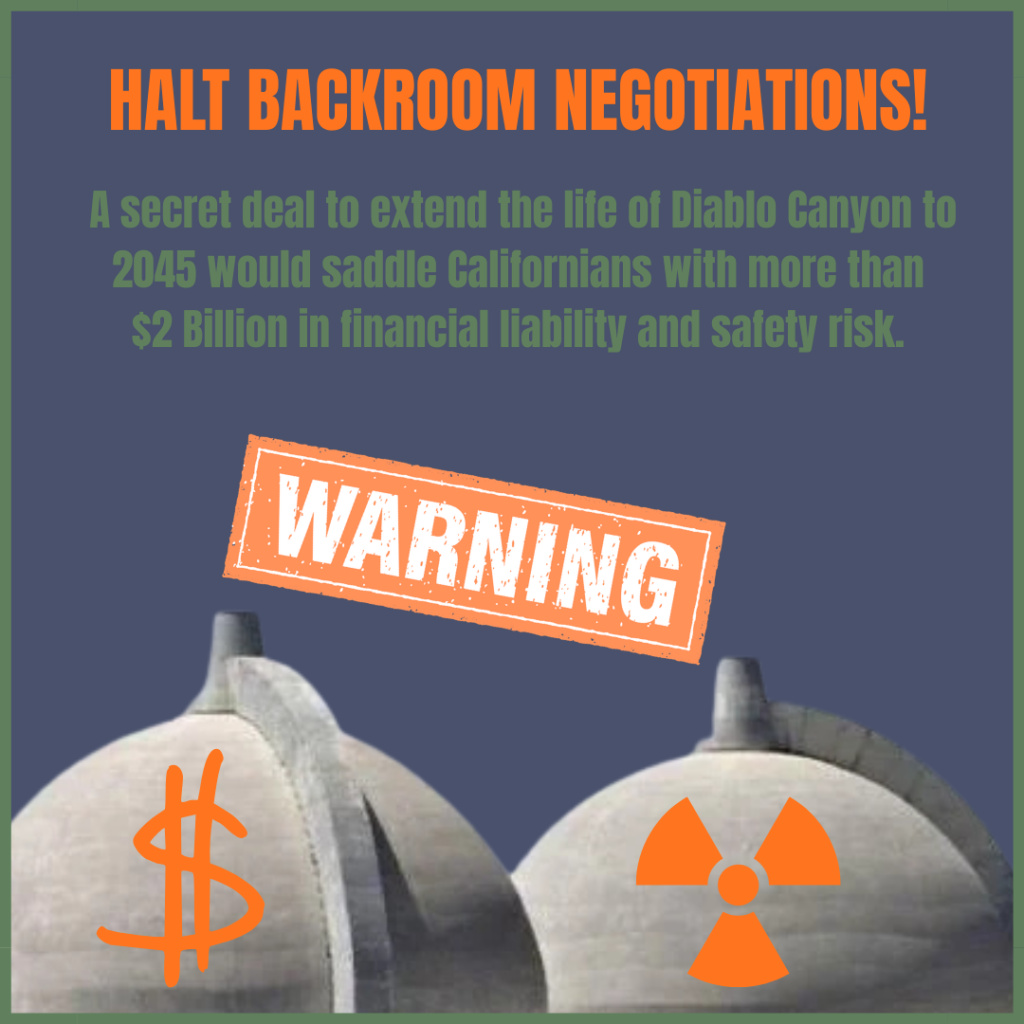
Diablo Canyon nuclear plant was set to close in 2025, but a last-minute, dark-of-night deal (Senate Bill 846) gave the plant five years of extended operation until 2030 – and billions in public subsidies. Now they’re trying to extend the plant again until 2045 without comprehensive assessments of need, affordability, and safety.
The aging Diablo Canyon nuclear plant SHOULD NOT be subsidized by Californians because it is:
Too Expensive
Diablo Canyon doesn’t pay for itself. Excess fees paid by ratepayers and taxpayers are subsidizing the 5-year extension of this aging plant while PG&E makes record profits. The California public is paying over $3.25 billion in additional fees and tax dollars for just the current 5-year extension of the plant (UCSB the 2035 Initiative). This is subsidizing PG&E’s third consecutive year of record profits, well over $2 billion annually.
PG&E continues to seek multi-billion dollar rate increases. Meanwhile, 1.9 billion California rate payers struggle to pay their electric bills. Proponents allege savings, but their “savings” is actually just a delay in implementation of renewables – something that does NOT support our clean energy future.
PG&E is asking for $658.6 million to pay off a $1.4 billion state loan intended to fund the 5-year extension. The state has not decided who will pick up the tab – PG&E’s overcompensated stockholders or customers and taxpayers.
Proponents of extended operation of Diablo Canyon cite a so-called “MIT Study” (in fact a commentary by John E. Parsons) as providing economic justification for their position. But the economic “savings” is mainly coming from a divestment in renewable energy projects.
Unnecessary
California’s power supply system already has sufficient clean energy and storage capacity to meet demand through 2036 and beyond.
Threatens Public Health
There is risk of an accident at Diablo Canyon – by natural disaster, human error, system failure, or act of terrorism. Remember Santa Susana Field Laboratory, Three Mile Island, Chernobyl, and Fukushima.
Seismic Risk
The long-postponed seismic update studies have not yet been completed for multiple significant earthquake faults surrounding the plant. The nine recommendations to assess these fault lines that were provided by the Independent Peer Review Panel, but have not been resolved.
Storage of High Level Radioactive Waste
The federal government has failed to license a permanent nuclear waste storage location (aka repository), which means the nuclear waste will remain onsite at Diablo Canyon – making it a de facto nuclear waste dump. The radioactive waste is currently being stored in overcrowded spent fuel pools and in dry casks. Both of these systems have been designed as temporary storage, not a permanent solution.
Spent nuclear fuel mismanagement poses a major threat to the United States, Bulletin of the Atomic Scientists, Mark Leyse, 2024.
Expert Explains How to Fix America’s 100,000-Ton Nuclear Waste Crisis, video featuring former NRC Commissioner Allison Macfarlane on nuclear waste, Wall Street Journal, 2026.
Exposure to Radiation
A 2026 study by the Harvard School of Public Health found that proximity to nuclear plants may be associated with increased cancer mortality. Meanwhile, the NRC is working to diminish rules protecting people from radiation in order to speed development and cut costs for new nuclear reactors.
US nuclear power regulator proposes changing rule protecting people from radiation, Reuters, Timothy Gardner, 2026.
Harms the Marine Environment
Diablo Canyon nuclear plant is the largest discharger of pollution in California, earning the nickname “California’s largest marine predator,” by former California Coastal Commission staff.
The facility’s once-through cooling system draws in 2.5 billion gallons of seawater each day. This process kills larvae and eggs, plankton, and larger marine life like fish, crabs, and shrimp. Additionally, the cooling system discharges the processed water back into the Diablo Cove 20 degrees warmer, altering the local marine habitat.
The Clean Water Act requires Pacific Gas & Electric to modify its cooling system or shut down. The State Water Resources Control Board has granted numerous exemptions and extensions over the years to accommodate the state’s last nuclear plant. The current deadline for closure or modification is 2030.
Central Coast Water Board adopts new water quality permits for Diablo Canyon Nuclear Power Plant, 2026.
The CA Coastal Commission, however, has granted approval for its harmful cooling system for another 20 years. Environmental Groups Condemn CA Coastal Commission Decision to Extend Diablo Canyon Nuclear Plant for Another 20 Years, Environmental Defense Center, 2025.
Inhibits Renewables
Running Diablo Canyon 24/7 is currently crowding out less expensive and more climate-friendly renewables and storage on the grid. In 2016, PG&E recognized the need to shut the plant:
“Given California’s energy goals that require increasing reliance on renewables—at least 50 percent by 2030—the California electric system will need more flexible resources to integrate renewable energy and has less need for baseload electricity resources. PG&E’s need for baseload power from Diablo Canyon will decrease after 2025.”
As recognized by California Energy Commissioner Siva Gunda, continued operation of Diablo Canyon beyond 2030 would crowd out renewables and thereby depress their growth.
There is no reason for the State to incur the financial, safety, and environmental risks when cleaner, safer and more affordable alternatives are available.